
We would like to hear from you regarding any of the topics that appear on this site.
There are several topics on the Community menu, including:
- Our Benefactor Program campaign
- Providing a free copy to each of the living carvers whose name appears in the book
- Mailing List
- What’s your Favorite
- Name that Carver
- Reviews/Testimonials
Book Eventss ~ 2026
Book Events ~ 2026
Scheduled
Collected Works Bookstore, Santa Fe, NM ~ Nov 23 @ 6pm
Completed
Gallup Ceremonial ~ August 7 – 8 @ Perry Null TradingPost
Santa Fe Indian Market ~ August 14 – 15 @ Malouf on the Plaza
Labor Day Weekend~ September 4-6 @Tanner Tradition, Ruidoso, NM
Ruidoso Public Library ~ October 2, 1:30-2:30pm
Southern New Mexico Book Festival ~ October 3 @ Las Cruces NM
For more information, send us a message [click here] or call 303-999-6449
Be a Benefactor
Be a Benefactor
The Benefactor Program
Purchasing a copy of Releasing the Spirit is beyond the means of most carvers. However, they would benefit from owning a copy in the following ways:
- Seeing their names in print and being recognized for their contributions to Zuñi fetish carving
- Understanding the backstory of their trade, as well as the extent to which it has permeated the public interest in Zuñi fetishes
How the Benefactor Program works
A copy of Releasing the Spirit will be provided to each living artist mentioned in the book. You can pay for any number of copies of a fixed amount. Contact us to enroll as a benefactor. We will send you a brochure explaining the program in detail.
Our goal is to raise $25,000 to fully fund the benefactor program.
In the event this program is fully funded before your gift arrives, your donation will be returned to you.
List of Benefactors
Anonymous
Nina Heflin ~ Navajo Trail Trading Post, Cameron, AZ
Roget Thomas ~ Halona Plaza, Zuñi, NM
Sandy Gardner ~ collector, Lawrenceville, GA
Scott Malouf ~ Malouf on the Plaza, Santa Fe, NM
Mailing LIst
Mailing List
What's Your Favorite?
What's Your Favorite?
Are there a few images in the book that you would classify as favorites?
If so, send us the page number, the image caption and a brief statement of your reasoning.
Use the Contact Form to submit your thoughts.
Here are the favorites we have received so far:
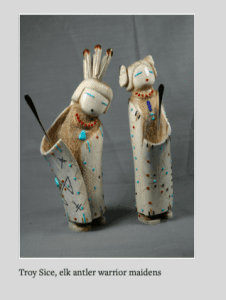
Page 373 ~ elegant and calming images
submitted by
Summer Snider
Charleston, SC
Name that Carver
Name that Carver
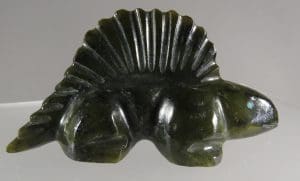
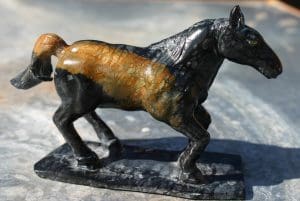
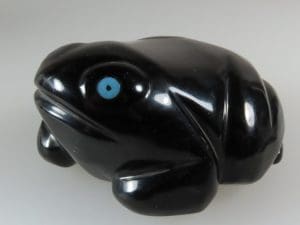
There are a number of images throughout Releasing the Spirit that are not attributed, some from the first half of the 20th century, some later (post-1950) and even some recent ones.
Rather than guessing who might have made a particular carving, they are labeled as “Unknown Zuñi” if it was Zuñi-made. Likewise, some (most likely non-Zuñi) were simply labeled “Unknown.”
Here are a few of the nearly 100 images for which we do not have certain attribution:
If you can help identify or have a guess at who made it, please send the page number and your best guess using the Contact Form. We will post your suggestions and will change the attribution in subsequent editions of the book.
Reviews/Testimonials
Reviews/Testimonials
“Releasing the Spirit” is an ambitious two-volume work that finally gives collectors and gallery owners a single, coherent map of the field. Volume I lays essential groundwork—clear explanations of the we’ma:we spirit idea, a concise backstory from Cushing to the present, and practical tours through materials and carving stages. Volume II is the payoff for buyers: deep profiles of families and masters plus a rich chapter on fetish necklaces.
Across both volumes the visuals are unmatched—nearly 1,100 photos shot over decades—backed by timelines, maps, a carver surname pronunciation guide, and even step-by-step carving details that separate coffee-table gloss from real knowledge.
Finkelstein writes as a veteran trader with 40+ years in the community, not an academic, which makes the book readable, candid, and useful. Collectors will value the straight talk on attribution, and where older pieces might surface; new readers will walk away actually understanding why Zuni fetishes feel alive and how carvers “release the spirit.”
Bottom line: if you buy, sell, collect, or teach this art, this is the reference to own.
Jason Arsenault
Native American art specialist
Gallup, NM
Dr. Finkelstein’s many years of personal relationships and interactions with the Zuñi people adds rich layers to this account of Zuñi history, genealogy, customs, and fetishes for all time!
Lois Joseph
Mudhead Gallery
Denver, CO
With the amount of information contained within these two volumes, the reader could spend years absorbing it all. The purpose of this masterful and gripping book is to honor the carvers both past and present who have carved intricate tactile and spiritual pieces.
Janis C. Munro
collector
Lake Quivira, KS
Message sent to J. Willam Powell, Director of Bureau of Ethnology in 1881. “Mr. Cushing’s duties in Zuni were preformed with intelligence and zeal throughout”. The same can be said of Harold Finkelstein’s “Releasing the Spirit”. A remarkable read on a wonderful subject. Every bookshelf should have a copy!
Michael Arnest
SantaFeTrade
Santa Fe, NM
“Releasing the Spirit” may well become the premier written guide to Zuni fetishes. This 2-volume set with a myriad of full color photos includes an evolution of styles by dedicated Zuni artisans of the last half of the 20th century and even more recently. The reader is provided not only with a reference guide but is introduced to the modern day artisans of these Zuni creations. ‘Authenticity Explained’ would be an appropriate subtitle for Chapter 12 which explains everything one would want to know about Zuni fetish necklaces. It serves as a guide to the carvers dedication to establish and maintain a quality standard with attention to detail that takes Releasing the Spirit to a higher level. This book sets a high bar for further exposition on this highly-collectible art form.
William R. Slay
Jackie’s Trading Post
Taos, NM
This book is a powerful tribute to the carvers and their wondrous work. I now have a much deeper understanding of Zuñi fetish carving and how it honors both tradition and artistry.
Mary Moon
Collector
Edgewood, NM
Dr. Harold Finkelstein’s Releasing the Spirit: The Art of Zuni Fetish Carving is more than an art book—it is a cultural history, a family chronicle, and a meditation on creativity and tradition. Dr. Finkelstein undertakes an ambitious project: to weave together a history of the Zuni Pueblo, an exploration of the artistry and purpose of fetish carving, and an account of the families and individuals who sustain the tradition. Spread across two volumes, the work blends anthropology, art history, and collectible lore into a single, beautifully presented package, offering readers not only a guide to collectible art but also a cultural narrative that spans centuries.
The first volume, Out of the Past, places Zuni fetish carving within centuries of Pueblo life, trade, and holistic worldview. Finkelstein explains how these small animal carvings are shaped from natural materials – turquoise, shell, stone – and understood as vessels of spirit. His prose is generally straightforward and accessible, though moments of lyricism surface, particularly when describing the carver’s role in “releasing the spirit contained within the raw material.” The emphasis on history ensures readers never lose sight of the carvings’ cultural roots, even as they admire them as art objects.
The second volume shifts to the present and future, offering intimate portraits of Zuni families of carvers and individual artists within those families. These chapters humanize the tradition, reminding readers that each fetish is not only an object but also a trace of a living hand. The book concludes with a provocative look forward to 2070, speculating on the evolving role of fetish carving in a globalized art market. This narrative arc—past to present to speculative horizon—gives the work unusual breadth and intellectual ambition.
What elevates Releasing the Spirit beyond scholarship is its visual richness. The photography is exquisite—page after page of carvings rendered in crisp, luminous detail. These images make the book as much a gallery as a text, allowing readers to linger over the individuality of each piece. These photographs elevate the book to the level of an art object in its own right.
If the book has a limitation, it is that its academic tone sometimes creates distance, and one wishes for more direct voices from Zuni carvers themselves. Still, Finkelstein’s respect for the tradition is evident throughout, and his decision to situate fetish carving in both cultural and artistic contexts makes the book unusually comprehensive. The declarative, almost textbook-like style ensures a steady pace of information. The effect is hybrid: half art-historical study, half cultural chronicle.
Ultimately, Releasing the Spirit is a work of both beauty and substance. Collectors will treasure its detail, historians will value its breadth, and general readers will find themselves drawn into the artistry of a tradition that remains vibrantly alive. More than anything, the book insists that each carving is not a trinket but a material embodiment of spirit, history, and artistry. If the ultimate aim of the book is to “release the spirit” of Zuni art into wider appreciation, then it achieves this with elegance and authority.
Nila Brown
Brown’s Trading Co.
Safford, AZ
This two-volume masterpiece is well-written and beautifully illustrated. It draws in even those, like me, with no prior knowledge of Native American art and culture. ‘What is a fetish’? The author’s involvement with Zuñi life and traditions over the past nearly half century is apparent. I found Dr. Finkelstein’s book to be captivating and informative.
Dr. Arthur Provisor
MD retired
Columbus, GA
As a collector of Zuñi fetish carvings for many years, I’ve often wished I had a knowledgeable friend who would let me tag along during visits with the Native American artists.
Dr. Harold Finkelstein is the perfect guide to the world of Zuñi fetishes. His book, “Releasing the Spirit / The Art of Zuñi Fetish Carving,” provides not only in-depth information into the history and customs of the Zuñi people, but also insights into these carvings as a vibrant American art form.
This is a masterful book well worth the journey. Dr. Finkelstein’s comprehensive narrative brings the reader close to the Zuñi carvers he knows so well, and the book’s photo galleries of fetishes made by multiple carvers over the years are simply extraordinary.
Even before I read Releasing the Spirit I knew I had Zuñi “fetish fever.” But now it’s a five-alarm fire!
Susan D. Phillips
Attorney and winery owner (retired)
Denver, CO
15+ years ago, I accompanied my friend and mentor, Harold Finkelstein, now of 60 years, to the Zuñi Pueblo. What I observed and experienced is accurately portrayed in this book. His interactions with carvers, his respect for their individuality, genius and culture and his desire to bring their story to the general public is beautifully-portrayed. He is accurately celebrating the lives and creations of many of the Zuñi carvers.
Of particular interest are the two chapters on the ‘masters’ ~ four families that optimize the essence of carving ~ artistry and execution – several of whom I met and interacted with.
I am a life-long artist and, yes, have been a fetish collector for decades. I see in the images presented in this magnificently-designed book the creativity of individuals carrying forward the traditions of their millennial-long heritage to new heights of artistic expression.
Len Garon
LenGaron.com
Alexandria, VA
In a book filled with insights, the one that stands out for me is that the Zuñi people are in the forefront of a vibrant indigenous culture that has had a fascinating past, an engaging present and an optimistic future. The author leaves no stone unturned (or un-carved for that matter) as he explores numerous universal truths regarding the aesthetic aspects of the carvings. He dutifully covers the business-end of their creations, all rendered in a wonderfully readable fashion.
The reader is offered the opportunity to explore in every detail (see the paragraph on ‘nostrils’) the beauty that this ancient art form has to offer.
One of the key elements of the book is the importance of relationships. This can be seen in the animistic view point of the carvers with their connection to nature, the trust between the artist and the traders and finally the powerful feeling collectors receive when holding the final image in their hands. Releasing the Sprit indeed.
Leo Brereton
Educator and Fetish Trader
(living/working in Zuñi in the 1980s)